To All Presenters:
Borrowing from Ken Robinson - why is it all children think they are creative, and most adults think they are not? What happens to us as we age that stifles our creative abilities?
What was the last truely creative thing you did?
I don't mean the last painting you painted, last doodle you doodled or last musical masterpiece which driped harmoniously from your mind's eye. Though, such activites certainly qualify.
When was the last time you looked back and said, "Yea, what I just did was different."
Did you jump up on a desk to start a presentation? Start presenting from the back of the room?
Did you look at the way something has always been done, and suddenly see the way it could be done better?
How did you last innovate, create or by some means or fashion move the needle forward by applying a different perspective to what would otherwise have been just another . . . whatever?
Has it been to long?
Why do we fall into the trap of creating "new sameness"? How do we get out of the trap after falling into it?
Food for creative thinking.
THE POINT: The business world is seeking creative thinkers and problem solvers - if you can' t remember the last creative thing you did, why would they hire you?

Thursday, April 1, 2010


Tuesday, March 30, 2010
Egad . . . IPAD
To All Presenters:
Previously I wrote that I couldn't understand why someone would pay for an oversized IPhone that didn't make calls.
Not only are people buying the IPAD, but they are buying it in droves since online sales began March 12 - one must be impressed by Apple's marketing.
Consider this, according to Victor Castroll, an analyst with Valcent Financial Group Apple earned about $72 million in revenue after one day's web sales, selling a product 99.99% of consumers had, at the time, never touched or seen in real life.
Pricepoint may be a contributing factor, but bottomline - that is serious brand loyalty.
THE POINT: A strong brand moves merchandise.
Monday, March 22, 2010
Marketing Makes Products Unique
To All Presenters:
In 1997 self-made billionaire Sidney Frank introduced a new brand of vodka designed specifically for success in the American marketplace. An experienced brand-builder, who acquired the North American import rights to Jagermeister and turned it into a mainstream success, Frank saw an opportunity to reinvent the concept of "top-shelf" vodkas. Market research had proven that a perception existed amongst the target population that French made products were perceived as high-end and quite desirable. So Frank, went to France.
The end product was produced from French Winter Wheat which is grown in an area south of Paris, then distilled in a column still using a particular variety of alpine spring water. This water had been gathered after self-filtering through the limestone plateaus of the Massif Central - a volcanic region in South-Central France. Final distillation of the vodka takes place in Cognac, France.
The packaging for this product was unique as the bottle's aesthetic blended images from the exterior front with images etched into the interior rear of the vessel. The result is a seemingly holographic image magnified by the liquid in the bottle. Rather than employ the traditional twist-top common among competing vodkas, Frank's vodka used a cork to conjure wine experiences and thus reaffirm for the consumer that this was indeed a high-end French product.
The advertising was aligned with singular events called the "Discerning 5" - a stay at a top hotel, dinner at a fine restaurant, sailing a yacht or exotic travel opportunities that would appeal to high society participants, or those who perceive themselves as such. Partnerships were established with the best night clubs and eateries in the marketplace - at it's launch Sidney Frank's vodka had exclusive domain over its beverage category at VIP tables across the U.S.
So . . . given the United States government declares any beverage retailing as "vodka" must be an "odorless, colorless, tasteless liquid with a proof between 78 and 103" one must be impressed that Mr. Frank sold his Grey Goose brand for $2 billion to Bacardi in the largest single brand sale ever.
Sidney Frank himself net nearly $1.6 billion from the sale, having successfully created a new product class through tangible differentiation in a beverage category characterized as having almost no physical properties whatsoever.
THE POINT: Creativity in marketing can be the genesis for product differentiation, and differentiation drives sales.
Friday, February 19, 2010
A Fool and His/Her Money
To All Presenters:
Good marketing empowers consumer emotions to overide common sense.
Exibit A: The IPAD.
THE POINT: There really isn't one - I just can't believe people are spending big dollars on an oversized IPHONE that doesn't make calls.
Good marketing empowers consumer emotions to overide common sense.
Exibit A: The IPAD.
THE POINT: There really isn't one - I just can't believe people are spending big dollars on an oversized IPHONE that doesn't make calls.
Friday, February 5, 2010
Doesn't Quite Explain Wing-Dings Though
To All Presenters:
On June 12, 2005 Steve Jobs was invited to deliver the commencement speech at Stanford University. The broad topic of his presentation was one never really knows what experiences are going to be critical to one’s life, until one has a chance to look back and see the coincidences.
Perhaps the most significant formative experience in Steve Jobs’ life, the one he spent a good amount of time emphasizing in his speech, was the advantages of dropping out of college. This is why Steve is never invited to speak at orientation.
Dropping out of college allowed Steve the opportunity to take courses he wanted to take, to learn about things he found interesting instead of being compelled to learn what the institution required to confer a degree. So amongst other seemingly random academic explorations - Steve Jobs took a calligraphy class. There he was introduced to the beauty of serif and san serif typefaces, to the importance of varying the space between characters and to the impact an artist could achieve when curvy waves of copy are juxtaposed with more rigid blocks of text.
Steve enjoyed the class. The memory of the experience and the acquired knowledge stayed with him even as he moved away from an academic setting and stepped onto the 10-year path that would ultimately define Steve’s personal and professional life.
The original Macintosh computer was designed to serve as the first home-use personal computer, but was soon positioned as a creative tool. The system launched the age of desktop publishing, which some original programmers saw as a computer combination of typewriter / layout table - fairly sterile, but easy to manipulate. Steve saw publishing as an art form – he saw publishing as design. As part of this evolution he called upon his experience in the calligraphy course many years before. He wanted to provide the creative population who would become the first true graphic designers of the computer age with a complete toolset they could use to achieve their artistic vision. Thus the Mac became the first computer with truly beautiful typography, and Tahoma, Arial, Times New Roman, along with the power of proportionally spaced fonts - found their way into a computer.
The conceptual leap around the techno-sphere was simple, since Windows copys everything Mac does (per Steve) they too included a variety of font selections in their software. This universality of concept gave birth to a cottage industry where artists design new fonts for computer applications - after a few short years this became multi-million dollar enterprise.
Henceforth creativity abounds, and that which was unheard of outside high-brow calligraphy courses is now considered a technology standard, because Steve Jobs dropped out of college and audited an art class.
THE POINT: Embrace innocuous opportunity – you never know where the next game changing idea will come from.
Friday, January 22, 2010
This Stage is Mine
To All Presenters:
Own the stage.
Give it back.
Never underestimate the power of silence.
Don't rush to start speaking after your introduction. Take a few seconds and allow all eyes to fall upon you. Allow the room to hush. In those precious moments know you are the authority in the room and stand quietly, maintain good posture, make eye contact with a few members of the audience and project "command presence". Then speak. The simple passing of time between the introduction and your performance is important as it allows the room to calm and focus, allows you to get comfy with the attention on you and allows you to assume control of the stage.
Silence is important at the end of your performance as well.
Make your final point - to a person. Maintain eye contact - with that person. Then turn to another person, and say "thank you". Then enjoy the applause. Don't run off the stage, take a moment to enjoy the gratifying sensation of a job well done.
If nothing else, hearing this validation makes it easier to step into the spotlight next time.
Own the stage.
Give it back.
That is all.
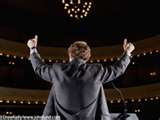
THE POINT: Own the stage, work the room, deliver your message well and make them remember you.
Own the stage.
Give it back.
Never underestimate the power of silence.
Don't rush to start speaking after your introduction. Take a few seconds and allow all eyes to fall upon you. Allow the room to hush. In those precious moments know you are the authority in the room and stand quietly, maintain good posture, make eye contact with a few members of the audience and project "command presence". Then speak. The simple passing of time between the introduction and your performance is important as it allows the room to calm and focus, allows you to get comfy with the attention on you and allows you to assume control of the stage.
Silence is important at the end of your performance as well.
Make your final point - to a person. Maintain eye contact - with that person. Then turn to another person, and say "thank you". Then enjoy the applause. Don't run off the stage, take a moment to enjoy the gratifying sensation of a job well done.
If nothing else, hearing this validation makes it easier to step into the spotlight next time.
Own the stage.
Give it back.
That is all.

THE POINT: Own the stage, work the room, deliver your message well and make them remember you.
Wednesday, January 6, 2010
Deaf or Just Not Listening?
To All Presenters:
Effective communication requires multiple parts:
Encoding (the speaker translates conceptual thoughts into words);
Transmitting (those words are spoken aloud in a common language);
Receiving (those words are heard by the audience);
Decoding (those words are understood and translated into concepts).
Those last two steps - Receiving and Decoding could easily be lumped together in a gushy ball and called "listening". While your delivery of a message certainly comes with its own opportunities for failure - listening is most commonly where the train goes off the tracks, over the cliff, into the ravine and bursts into flames upon the jagged rocks hundreds of feet below.
More scientific communicologists than I will oft divide listening into three categories:
Competitive or Combative Listening happens when one is more interested in promoting one's own perspective than in understanding or exploring someone else’s. In this case the listener either seeks opportunities to speak, or focuses on finding flaws or weaknesses in a presentation which can be attacked. This type of listening is all too common in audiences - and seems especially popular during product demos and sales presentations.
Passive or Attentive Listening occurs when one is genuinely interested in hearing and understanding the another's point of view. One may be attentive and passively listen without actively verifying what was understood to be said. This type of listening generally results in subsequent discussions of the, "I know you think you understand what you thought I said, but what you thought I said isn't what I meant" type most common in IT development projects and marriages.
Active or Reflective Listening is the single most useful and important listening type. In active listening one is so genuinely interested in understanding what another person is thinking, feeling, wanting or what the message really means. To that end the recipient will reiterate or paraphrase the message and reflect it back to the sender for verification. This verification or feedback process is what distinguishes active listening and makes it the most effective means of assuring accurate communication. It's also how lawyers badger witnesses.
Of course there are alternative opinions.
Robert K. Cooper, popular leadership consultant and author, says, "Many 'active listening' seminars are, in actuality, little more than a shallow theatrical exercise in appearing like you're paying attention to another person. The requirements: Lean forward, make eye contact, nod, grunt, or murmur to demonstrate you're awake and paying attention, and paraphrase something back every 30 seconds or so. As one executive I know wryly observed, many inhabitants of the local zoo could be trained to go through these motions, minus the paraphrasing."
THE POINT: Better, perhaps, to consider a quote from Frank Tyger, "Be a good listener. Your ears will never get you in trouble."
Subscribe to:
Posts (Atom)